
In oil and gas drilling solid control systems, shale shakers and mud cleaners are two critical components that work sequentially to purify drilling fluid—yet they serve distinct roles, target different particle sizes, and employ unique technologies. Understanding the differences, complementary functions, and optimal integration of shale shakers and mud cleaners is essential for maximizing drilling efficiency, reducing operational costs, and protecting downstream equipment. Shaanxi Aipu Solids Control Co., Ltd. (AIPU), a leader in drilling mud solids control, has engineered high-performance shale shakers and mud cleaners that synergize seamlessly, setting industry standards for solid-liquid separation. This article compares shale shakers and mud cleaners in detail, highlighting their core differences, collaborative value, and AIPU’s innovative offerings.

1. Core Positioning & Functional Differences
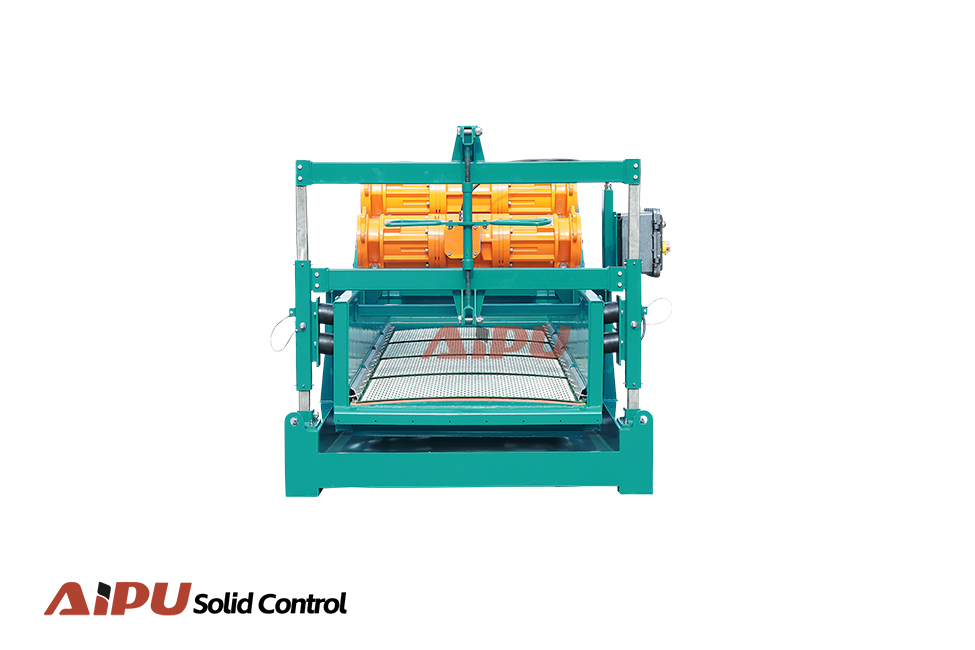
1.1 Shale Shaker: The “First Line of Defense”
- Role: As the primary stage of solid control, shale shakers are the first to process drilling fluid returning to the surface. Their core function is to separate large and medium-sized solid particles (cuttings) from drilling fluid, preventing clogging or damage to downstream equipment.
- Target Particles: Focuses on removing particles ≥74μm (typically 74-2000μm), accounting for 80-90% of total solids in returned drilling fluid.
- Working Principle: Uses high-frequency vibration (linear, elliptical, or dual-motion) to drive the screen, allowing clean drilling fluid to pass through the mesh while transporting solid cuttings off the screen surface.
- AIPU Product Example: AIPU HUNTER-MG Shale Shaker (120-420m³/h capacity) and Hunter-MGD Dual-Motion Shale Shaker (180m³/h capacity). Key features include large screen area (up to 2.7m²), high-G force, and quick-replace screens—ensuring efficient separation of large cuttings with over 98% efficiency for particles ≥74μm.
1.2 Mud Cleaner: The “Second/Third-Stage Precision Separator”
- Role: A secondary/tertiary solid control device that follows shale shakers. It targets fine particles missed by shale shakers, further purifying drilling fluid to maintain its performance.
- Target Particles: Specializes in 15-74μm particles (the “critical fine particle range” that impacts drilling fluid viscosity and wellbore stability).
- Working Principle: Integrates desander cones, desilter cones, and a bottom shale shaker. Drilling fluid first passes through hydrocyclones (desander/desilter) for centrifugal separation of fine particles, then the bottom shaker removes residual solids—achieving dual-stage purification.
- AIPU Product Example: AIPU Hunter Series Mud Cleaner (e.g., Hunter240, 240m³/h capacity). It combines 4×12 desilter cones, 1×10 desander cone, and a Hunter-D3 bottom shaker, removing over 95% of 15-74μm particles. The high-G force bottom shaker and wear-resistant polyurethane cones ensure long-term stable operation.
2. Key Technical & Performance Comparison
| Comparison Dimension | Shale Shaker (AIPU Examples) | Mud Cleaner (AIPU Examples) |
|---|---|---|
| Separation Stage | Primary (first stage of solid control) | Secondary/tertiary (follows shale shakers) |
| Target Particle Size | ≥74μm (large cuttings) | 15-74μm (fine sand, silt) |
| Core Components | Vibrating motor, screen, shaker basket | Hydrocyclones (desander/desilter), bottom shale shaker, manifold |
| Separation Principle | Vibratory screening (linear/elliptical/dual-motion) | Centrifugal separation (hydrocyclones) + vibratory screening (bottom shaker) |
| Processing Capacity | 120-420m³/h (AIPU HUNTER-MG) | 120-320m³/h (AIPU Hunter Series) |
| Separation Efficiency | ≥98% for ≥74μm particles | ≥95% for 15-74μm particles |
| Structural Complexity | Simple (fewer components) | Complex (integrates multiple separation technologies) |
| Maintenance Focus | Screen replacement, motor lubrication | Cone inspection, screen maintenance, hydrocyclone cleaning |
| Adaptability | Handles high-viscosity fluid, heavy cuttings (AIPU dual-motion technology) | Adapts to variable fine particle loads, compatible with oil/water-based mud |
3. Synergistic Effects in Solid Control Systems
Shale shakers and mud cleaners are not competitive—they are complementary, and their optimized integration is critical for the overall performance of solid control systems:
- Load Reduction: Shale shakers remove 80-90% of solids, reducing the particle load on mud cleaners. This prevents mud cleaner hydrocyclones from clogging, extending their service life by 50% (per AIPU field data) and reducing maintenance downtime.
- Precision Purification: After shale shakers remove large particles, mud cleaners target the fine 15-74μm particles that affect drilling fluid properties. Together, they achieve a total solid removal efficiency of ≥99% for particles ≥15μm, maintaining drilling fluid viscosity and density within optimal ranges.
- Cost Optimization: The synergy reduces drilling fluid loss (recycling rate up to 94% with AIPU’s combined system) and lowers waste disposal costs. For a 100-day drilling project, this translates to $80,000-$150,000 in savings on fluid procurement and waste treatment.
AIPU enhances this synergy through system-level design:
- Matching Capacity: AIPU’s shale shakers (e.g., HUNTER-MG 240m³/h) and mud cleaners (e.g., Hunter240 240m³/h) have compatible processing capacities, avoiding bottlenecks in fluid circulation.
- Uniform Interfaces: Standardized inlet/outlet connections enable seamless integration, reducing installation time and ensuring smooth fluid flow between the two devices.
- Material Consistency: Both products use corrosion-resistant coatings and H2S-resistant steel options, ensuring compatibility in harsh drilling environments (e.g., offshore, high-sulfur formations).
4. AIPU’s Practical Application: Synergized Shale Shaker & Mud Cleaner
A large onshore shale gas drilling project in China faced challenges with high solid content in drilling fluid, leading to frequent equipment wear and high fluid replacement costs. The project adopted AIPU’s HUNTER-MG Shale Shaker (240m³/h) and Hunter240 Mud Cleaner as a combined solid control solution:
- Shale Shaker Performance: Removed 98.5% of ≥74μm cuttings, reducing the solid load entering the mud cleaner by 85%.
- Mud Cleaner Performance: Further removed 96% of 15-74μm fine particles, lowering the total solid content in drilling fluid from 15% to 2%.
- System-Level Results: Drilling fluid recycling rate increased from 70% to 94%, daily fluid loss reduced by 30m³, and downstream centrifuge maintenance frequency cut by 60%. The project saved $1.1 million in comprehensive costs, with the drilling cycle shortened by 12 days.
5. How to Choose: Key Considerations
- Based on Drilling Needs: Shale shakers are non-negotiable for all drilling projects (primary separation); mud cleaners are essential for projects with strict drilling fluid quality requirements (e.g., horizontal wells, HPHT wells, shale gas drilling).
- Based on Formation Conditions: In formations with high fine particle content (e.g., siltstone, shale), mud cleaners are critical to prevent drilling fluid thickening; in formations with large gravel cuttings, high-capacity shale shakers (e.g., AIPU HUNTER-MG 420) are prioritized.
- System Compatibility: Choose products from the same manufacturer (e.g., AIPU) to ensure capacity matching, interface compatibility, and seamless technical support.
6. Conclusion
Shale shakers and mud cleaners play distinct but interconnected roles in solid control systems: shale shakers act as the “first line of defense” to remove large cuttings, while mud cleaners serve as “precision purifiers” for fine particles. Their synergy is the key to achieving high-efficiency solid control, protecting equipment, and reducing operational costs. AIPU’s shale shakers and mud cleaners, with their advanced technologies (dual-motion vibration, wear-resistant hydrocyclones), compatible capacities, and system-level integration, optimize this synergy to deliver superior performance. For drilling companies seeking reliable solid control solutions, understanding the differences and collaborative value of these two components—paired with AIPU’s optimized products—will drive operational success in diverse drilling scenarios.
If you are interested in the article, please feel free to share it: https://shakerscreens.org/shale-shaker-screen/shale-shaker-vs-mud-cleaner-key-differences-synergies-and-aipus-optimized-solutions.html
If you are interested in our equipment, please feel free to contact me at info@aipusolidcontrol.com
